Changelings’ collective panic
The Amazing Maurice and His Educated RodentsThe Changelings’ collective panic is a collapse of speech and organized thought under the pressure of overwhelming fear. As rats flee from the crowded cages, the frightened response spreads through the group: even rats who could think and communicate begin to squeal, run blindly, or lose their grasp of one another. The episode exposes how easily a shared identity can be eclipsed by terror, and sets that breakdown against the discipline the Clan later recovers.
The Clan’s fragile boundary
Earlier, Dangerous Beans had argued that controlling a flame could distinguish the Clan from darkness and from ordinary rats. Hamnpork remained suspicious of the candle, objecting both to the danger and to the waste of food, but Dangerous Beans saw the flame as a declaration that the Clan was separate and more than rats. That conviction gives the later panic its particular force: the crisis is not simply that the rats are afraid, but that fear seems to undo the qualities by which they understand themselves.
The contrast becomes visible as the exploration party is overdue. Peaches notes that Darktan checks every step, but Dangerous Beans senses that something is wrong. He wrinkles his nose, then identifies fear in the air. His perception makes the approaching crisis legible before its cause is fully seen: terror is already moving through the tunnels, carried by rats who are fleeing rather than explaining what they have found.
Fear spreads through the tunnels
A rat rushes past the group, followed by others. When Peaches asks what is happening, Finest spins away without answering. Dangerous Beans senses more fear, while Toxie’s attempt to stop a runner ends with the rat biting him and continuing to flee. The response is contagious and physical: rats shove past, squeal, and gibber, while the companions struggle to make sense of behavior that would once have been unthinkable to them.
The decisive change is the loss of speech. Dangerous Beans realizes that the fleeing rats have forgotten how to talk. Peaches recognizes Feedsfour, whom she had spoken with only an hour earlier, among those now squeaking and dodging away. The short interval makes the reversal stark: these are not strangers or a permanently different group, but members of a community who had recently shared language and understanding. Dangerous Beans cries as he repeats his realization, and Peaches puts her paws around him as the fear overtakes them too. Toxie, who recalls that the rats once talked through their fear of a dog and trapped it together, also loses his focus; his fur bristles, his eyes stare past Peaches, and he runs.
The cages behind the panic
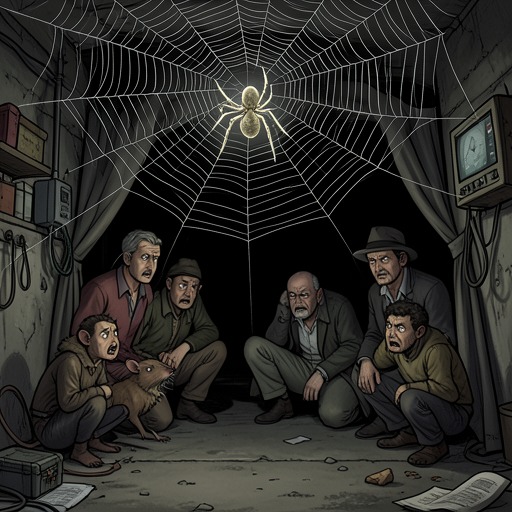
The source of the crisis becomes visible in the long room: cages are packed with rats from wall to wall and floor to ceiling. Bodies cling to the wire and netting, which strains beneath their weight; paws and noses thrust through the holes as the rats tumble over one another. The room is filled with squeaking, rustling, and chittering, and the stench intensifies the oppressive scene. Hamnpork’s exploration party has gathered near the middle, but most of it has already fled.
The scale of the imprisoned population helps explain why the discovery overwhelms the explorers. Maurice feels the pressure as soon as Keith breaks down the door: the crowd’s noise and presence bear on him like a headache outside his head. He stays back, recognizing that the situation may demand escape rather than conversation. The terror is therefore not only an individual reaction to a visible threat. It confronts the rats with a mass of trapped animals whose fear presses on the newcomers and threatens to turn their own group into another panicked crowd.
Making sense of a breakdown
Maurice later distinguishes an individual rat’s capacity for courage from the behavior of many rats crowded together and steeped in one another’s fear. He explains why the rats in rat-coursing do not fight the dogs: surrounded by panicked companions, they run in circles. In his formulation, a crowd can become a large animal with many legs and no brain. The observation clarifies the mechanism of the Changelings’ panic without reducing it to cowardice; terror changes what the group can do, disabling the speech and judgment on which collective action depends.
The danger also extends beyond the caged rats. Maurice tells Darktan that the rat-catchers hear the same influence but mistake it for their own thoughts. Dangerous Beans describes the others as having stopped thinking, and is distressed that even Toxie ran despite knowing how to write. The panic thus reveals a vulnerability shared across the crisis: language, learning, and individual intelligence do not automatically protect a rat when fear overwhelms the mind.
From flight to coordinated action
Darktan responds to frightened young rats by giving their danger a common purpose. At first the squad is almost cowering, but he tells them that they are something new: rats with brains, able to think rather than turn and run. He frames the unexplored tunnels through the image of the Dark Wood from Mr Bunnsy Has An Adventure, then presents the hidden threat as something they can confront together. His account of the Bone Rat gives the squad a way to imagine facing death without allowing fear to dictate retreat. The shift is not proof that danger has vanished; it is an attempt to restore a shared identity strong enough to act despite it.
Later, the Clan’s movement into a room of enemy rats provides a sharp counter-image to the earlier disorder. The rats advance together in a line. When an enemy attacks, the line closes over it like a fist; when terrified opponents try to escape, pairs break away to pursue them. The fighting ends within seconds. This is not the same as fearlessness, but it is a different use of group power: instead of spreading panic until speech and thought collapse, the Clan’s coordinated formation turns shared purpose into action. The contrast makes the panic a test of what holds the community together—and of how much is lost when terror breaks that bond.